






Location-based AR overlay
Uses the engineer's location to overlay network infrastructure onto the device camera view.
Accreditations








Case Study · BT — Openreach
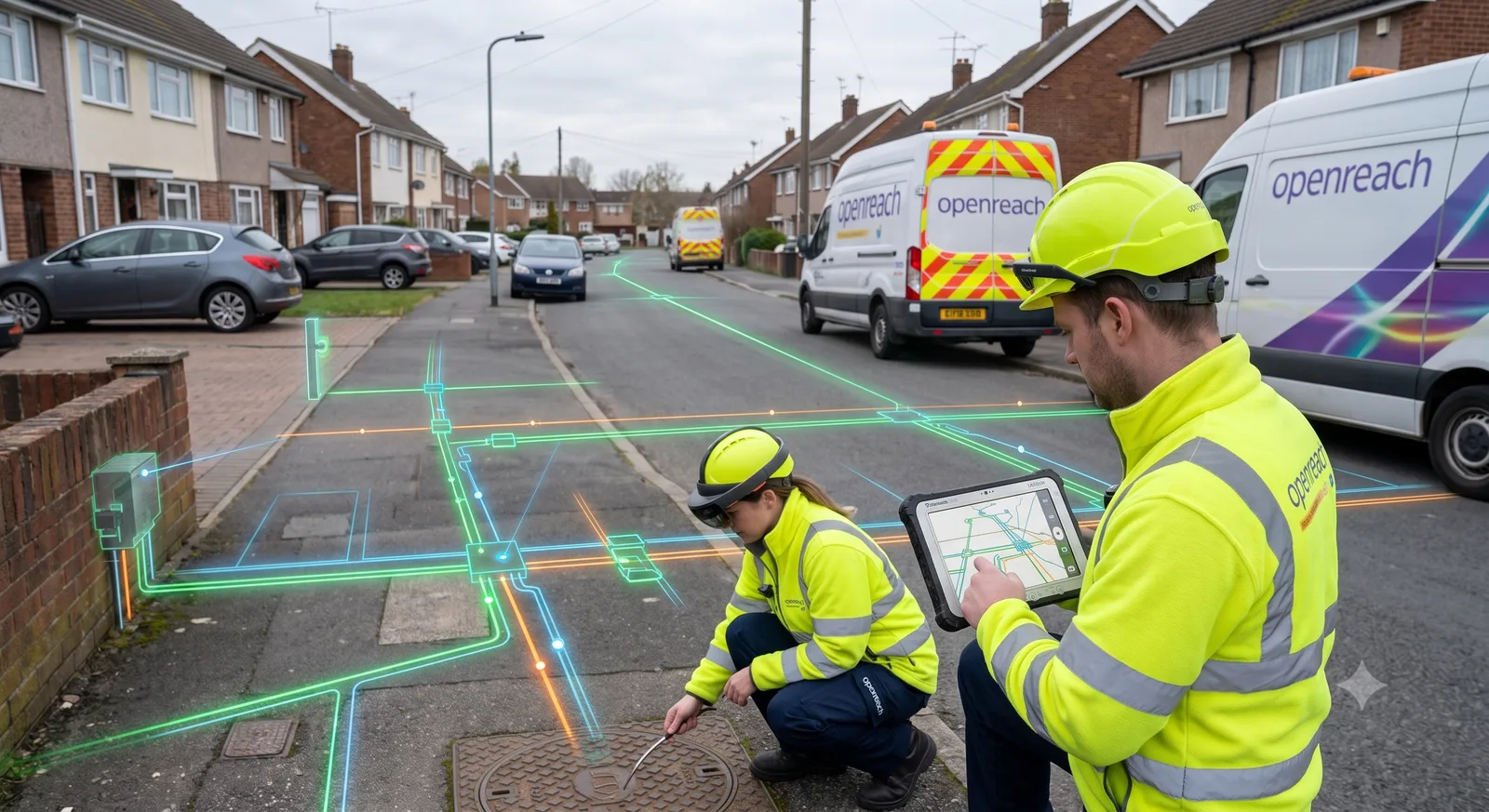
An immersive field-service solution using Augmented Reality (AR) and map visualisation for BT Openreach UK, so field engineers can confidently identify FTTP network infrastructure and correct routes using their location and BT's existing network data. Engineers overlay network assets onto the camera view, see per-node routing detail (Serving Splitter ID, spare CBT ports), highlight nodes on their route, and switch to an OS-map bird's-eye view — with installation and fix history on tap.
Industry
Telecom
Region
UK
Year
2024
Featured
Yes
Telecom / Field Service / Augmented Reality / Network Infrastructure
The solution was designed for field engineers working with FTTP network infrastructure. The core problem: engineers could find it difficult to locate installed network devices when they were underground, behind trees, behind other installations, or otherwise hard to identify visually. The solution uses Augmented Reality together with a map-based view, so an engineer can use their device at a location and see the network infrastructure digitally overlaid on the real-world environment — a bird's-eye view of installed devices, then an AR camera view on arrival.
Business requirements & challenges
The aim was to give engineers confidence identifying FTTP network infrastructure locations, correct routes and installed devices.
Major challenges
Solution
Following successful initial PoC research, the solution combines location-based network visualisation, Augmented Reality, network-infrastructure labelling, routing details and OS map integration — built around BT's existing network data and structure.
Stack
How it works
What's new
Uses the engineer's location to overlay network infrastructure onto the device camera view.
Labels network and associated infrastructure at each point, so assets are understood without full physical visibility.
Shows routing information such as Serving Splitter ID and spare CBT ports for each node.
Highlights the nodes on the engineer's route, focusing attention on relevant assets.
Switch between an AR camera view on site and an OS-map bird's-eye view with the same data on tap.
Provides the history of installations and fixes at the engineer's fingertips at the location.
Business benefits
At a glance
| Customer | BT – Openreach – UK |
|---|---|
| Primary Technology | Augmented Reality |
| Secondary Technology | Map Visualization |
| Network Focus | FTTP |
| Primary Users | Field Engineers |
| AR Capability | Network overlay on camera/device screen |
| Location Capability | Location-based infrastructure identification |
| Routing Details | Serving Splitter ID, Spare CBT ports, etc. |
| Route Feature | Highlight nodes on engineer's route |
| Map Feature | OS map / bird's-eye network view |
| History | Installation & fix history |
| Tech Stack | Swift, Apple ARKit, Unity 3D, Mapbox, Apple Maps, OpenStreetMap, Angular |
| Development Stage | Initial PoC successfully completed |
| Data Requirement | Existing customer network data & structure |
| UX | Intuitive and simple to follow |
Related
Telecom
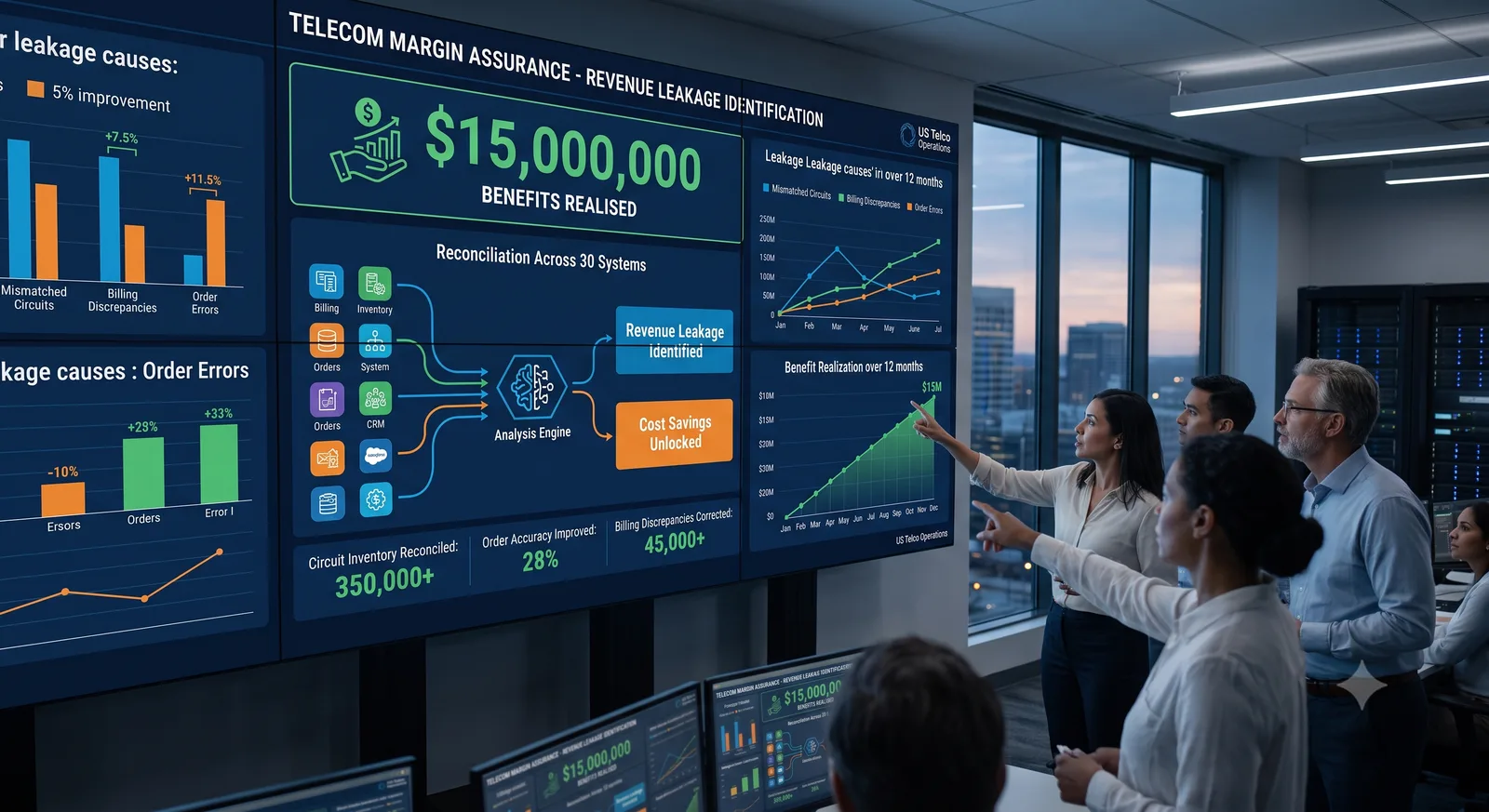
FeaturedA Revenue Assurance Framework for Telecom Inventory from Quote to Cash for a leading US carrier. Using Informatica PowerCenter ETL, a customised margin-assurance framework and Oracle/SQL Server databases, it reconciled ~13K customer sites, ~35K circuit records and ~6MN data points across 30 systems — plugging revenue leakage and uncovering recovery opportunities. It delivered >$15M realised benefits, >$9M revenue recoveries, >$3M new monthly revenue, >$6M annualised benefits and >$2M cost savings.
USA's top Telecommunications Carrier
US
$15M
benefits scorecard realised

Retail
Migrated SAP-based Supply Chain Management data to a Cassandra NoSQL database via the UDMF platform in phased waves, and established end-to-end daily reconciliation between the source systems and Cassandra — identifying expected-vs-actual stock variances, transaction anomalies and critical reconciliation issues for a leading US telco. Delivered $3M in cost savings through the RISP programme.
USA's top Telecommunications Carrier
US
$3M
cost saved through the RISP programme

Telecom
A supplier-invoice and revenue-assurance solution for a leading UK carrier — consolidating and reconciling supplier invoices into a single normalised database, validating third-party telecom spend, and identifying unused network elements still being billed. Automated network polling and reporting run it as BAU, an automated bill-stop halts charges for unused elements, and periodic audits verify billing has stopped. It delivered £135M in annual realised cost savings.
UK's top Telecommunications Carrier
UK
£135M
annual realised cost saving