






SAP → Cassandra migration
Migrates SAP-based supply-chain data to a NoSQL Cassandra database via the UDMF platform, in a phased approach.
Accreditations









Case Study · USA's top Telecommunications Carrier
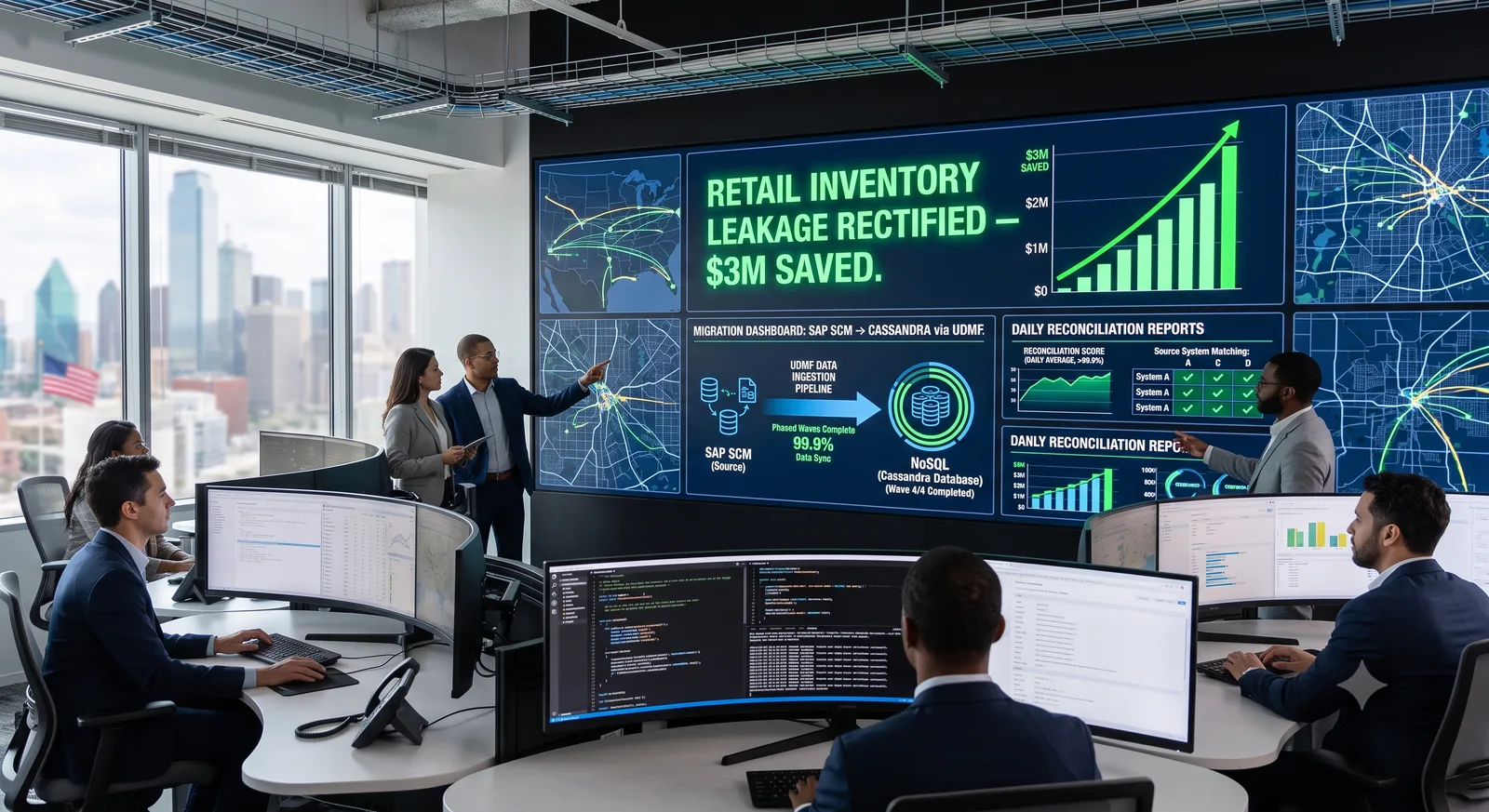
Migrated SAP-based Supply Chain Management data to a Cassandra NoSQL database via the UDMF platform in phased waves, and established end-to-end daily reconciliation between the source systems and Cassandra — identifying expected-vs-actual stock variances, transaction anomalies and critical reconciliation issues for a leading US telco. Delivered $3M in cost savings through the RISP programme.
Industry
Retail
Region
US
Year
2022
Retail / Supply Chain / Inventory Management / Data Reconciliation
The case study focuses on supply-chain data migration, inventory reconciliation and leakage/variance assessment. The customer needed to migrate its existing SAP-based Supply Chain Management data into a NoSQL Cassandra database using the UDMF platform, in a phased approach. Alongside the migration, the solution established a comprehensive daily reconciliation process between the various source systems and the Cassandra database — to identify and resolve discrepancies in inventory and transaction data and reduce inventory variances.
Business requirements & challenges
Migrating a complex supply-chain estate to a new data model — while proving, every day, that nothing was lost or mis-stated in the process.
Major challenges
Solution
A framework fetches data from ECC and OER SAP systems, then manages and analyses it to support data-quality analysis, migration reconciliation, transaction reconciliation and inventory analysis. Migration to Cassandra runs on the UDMF platform in phases, and a dedicated reconciliation framework performs end-to-end reconciliation of transaction data across systems.
Stack
How it works
What's new
Migrates SAP-based supply-chain data to a NoSQL Cassandra database via the UDMF platform, in a phased approach.
A reconciliation framework compares transaction data across tightly coupled systems end-to-end.
Computes expected stock from daily transactions and compares it with actual stock per store and SKU.
Highlights anomalies where transaction information doesn't correlate across systems.
Daily discrepancy reports feed PIER tickets for tracking and resolution.
Data-quality and migration-reconciliation reports verify migrated information matches the source.
Business benefits
Store-level stock variances and cross-system transaction anomalies were surfaced daily, and critical reconciliation issues were resolved to reduce inventory variances.
$3M
cost saved through the RISP programme
At a glance
| Customer | USA's Top Telecommunications Carrier |
|---|---|
| Primary Objective | Inventory leakage & reconciliation |
| Source Systems | SAP ECC + OER SAP |
| Target Database | Cassandra NoSQL |
| Migration Platform | UDMF |
| Migration Approach | Phased |
| Reconciliation | E2E transaction reconciliation |
| Transactions | Sales, Returns, Transfers, Receipts, Inventory Adjustments |
| Reporting | Daily reconciliation & discrepancy reports |
| Issue Tracking | PIER Tickets |
| Stock Analysis | Expected vs Actual (stores + SKUs) |
| Key Detection | Transaction anomalies |
| Cost Saved | $3M USD (RISP programme) |
Related
Retail
A robust L1 Help Desk and SIAM (Service Integration and Management) framework for a leading USA-based liquor store chain operating 800+ retail locations and 120+ head-office employees. Built on ServiceNow as the centralized incident and service-management platform, it logs, categorizes and prioritizes incidents, resolves common issues from a searchable knowledge base, automates escalation to L2/L3, and coordinates third-party vendors for major incidents via SIAM — across email, phone and web-portal channels. The result: reduced operational downtime, streamlined IT operations, enhanced service quality and data-driven decisions.
Leading USA-based liquor store chain
US
Retail
A versatile Point of Sale (POS) system covering retail sales and operational needs — inventory management, sales tracking and customer relationship management — built with customizable modules and integration capabilities on a cloud-based architecture for scalability, real-time data access and remote management, and secured with encryption and access controls. Delivers operational efficiency, an improved customer experience and data-driven decision-making.
Smart City
BCP Alive uses Augmented Reality on the High Street to rejuvenate it — attracting more people to visit, getting them to stay longer once they arrive, and making it easier to find what they're looking for. AR turns a simple retail experience into a richer visitor experience: attracting people to the High Street, entertaining them while they're there, and providing tailored information. Visitors choose points of interest from a list of attractions — top destinations, shops, restaurants, café & pub, museum, monuments and a virtual city guide.
BCP Council
UK