






Non-destructive & high-throughput
Scans large plant populations without requiring manual measurement.
Accreditations









Case Study · Plant Phenomics Centre, IARI
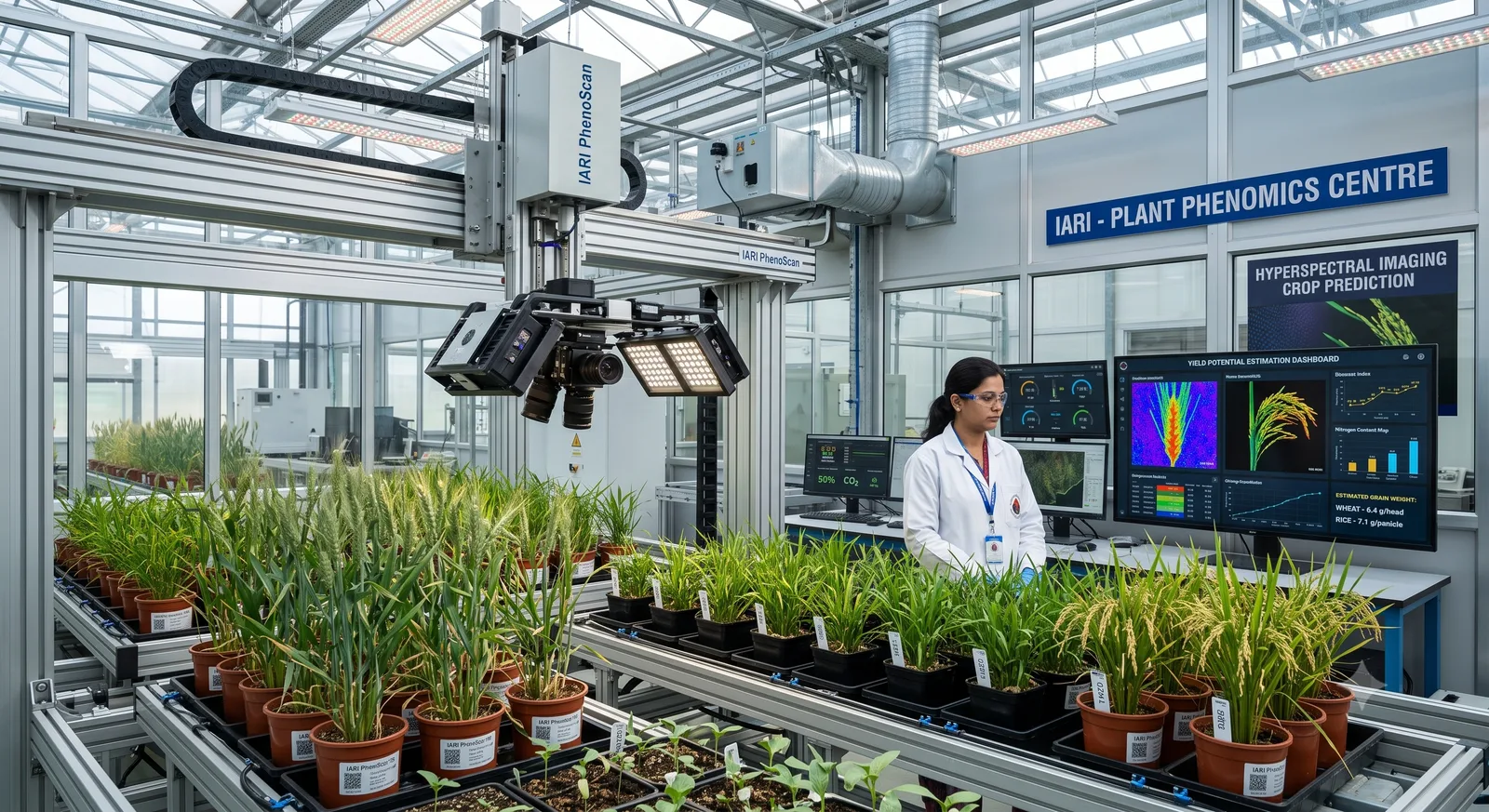
Hyperspectral image processing at the Plant Phenomics Centre, IARI — enabling accurate, early-stage, non-destructive crop-yield estimation for wheat and rice by correlating spectral signatures (photosynthetic efficiency, chlorophyll, water stress) with final yield.
Industry
Agriculture
Region
IN
Year
2023
Featured
Yes
Artificial Intelligence, Machine Learning & IoT
At the Plant Phenomics Centre, IARI, a major challenge was the lack of accurate, non-destructive, early-stage methods for estimating crop yield under different environmental and genetic conditions. Traditional approaches — conventional field trials, visual assessment and manual measurement — were labour-intensive, time-consuming, hard to scale, and often unable to capture subtle physiological changes affecting final yield, especially under stress. The project used hyperspectral image processing together with controlled environmental conditions to estimate the yield potential of wheat and rice.
Business requirements & challenges
The underlying requirement was to develop a method that could provide early, accurate and non-destructive crop-yield estimation.
Major challenges
Solution
Xpertnest implemented a hyperspectral image processing solution at the Plant Phenomics Centre, IARI. The system captures detailed spectral signatures from plants, identifies physiological characteristics associated with crop performance, and correlates them with eventual yield through data-driven models — enabling real-time monitoring and yield prediction across genetic and environmental scenarios.
Stack
How it works
What's new
Scans large plant populations without requiring manual measurement.
Can potentially be extended to UAV/drone and satellite imaging in the future.
Works across different crops and stress conditions with minimal retraining.
Gives breeders and agronomists real-time information to support plant selection, crop management and research decisions.
Business benefits
At a glance
| Crop | Wheat and Rice |
|---|---|
| Analysis | Plant Phenotyping |
| Imaging | Hyperspectral Imaging |
| Prediction | Early Crop Yield Potential |
| Measurement | Non-destructive |
| Processing | High-throughput |
| Conditions | Diverse environmental & genetic conditions |
| Physiological Parameters | Photosynthetic efficiency, chlorophyll, water stress and other traits |
| Scalability | UAV/drone and satellite imaging potential |
| Adaptability | Different crops and stress conditions with minimal retraining |
| Users | Breeders and Agronomists |
| Applications | Crop breeding, crop management, research, policy and precision agriculture |
Why it matters
India's need for food security, sustainable agriculture, faster breeding programmes and optimised field practices creates demand for technologies that improve crop research and agricultural decision-making. Accurate early-stage yield prediction helps researchers and policymakers make better decisions around genotype selection, crop management and resource allocation — establishing a stronger connection between phenotypic traits and actual yield potential through advanced technology.
Related
Agriculture
A comprehensive AI-based image-processing framework at the Plant Phenomics Centre, IARI — integrating RGB, hyperspectral and NIR imaging across controlled and field environments to assess wheat and rice traits: biomass, near real-time disease detection and scoring, nitrogen and water-level classification, NDVI soil-vegetation segmentation and trait-specific spectral analysis, feeding the AgriX decision-support tools.
Plant Phenomics Centre, IARI
IN
Agri & Manufacturing
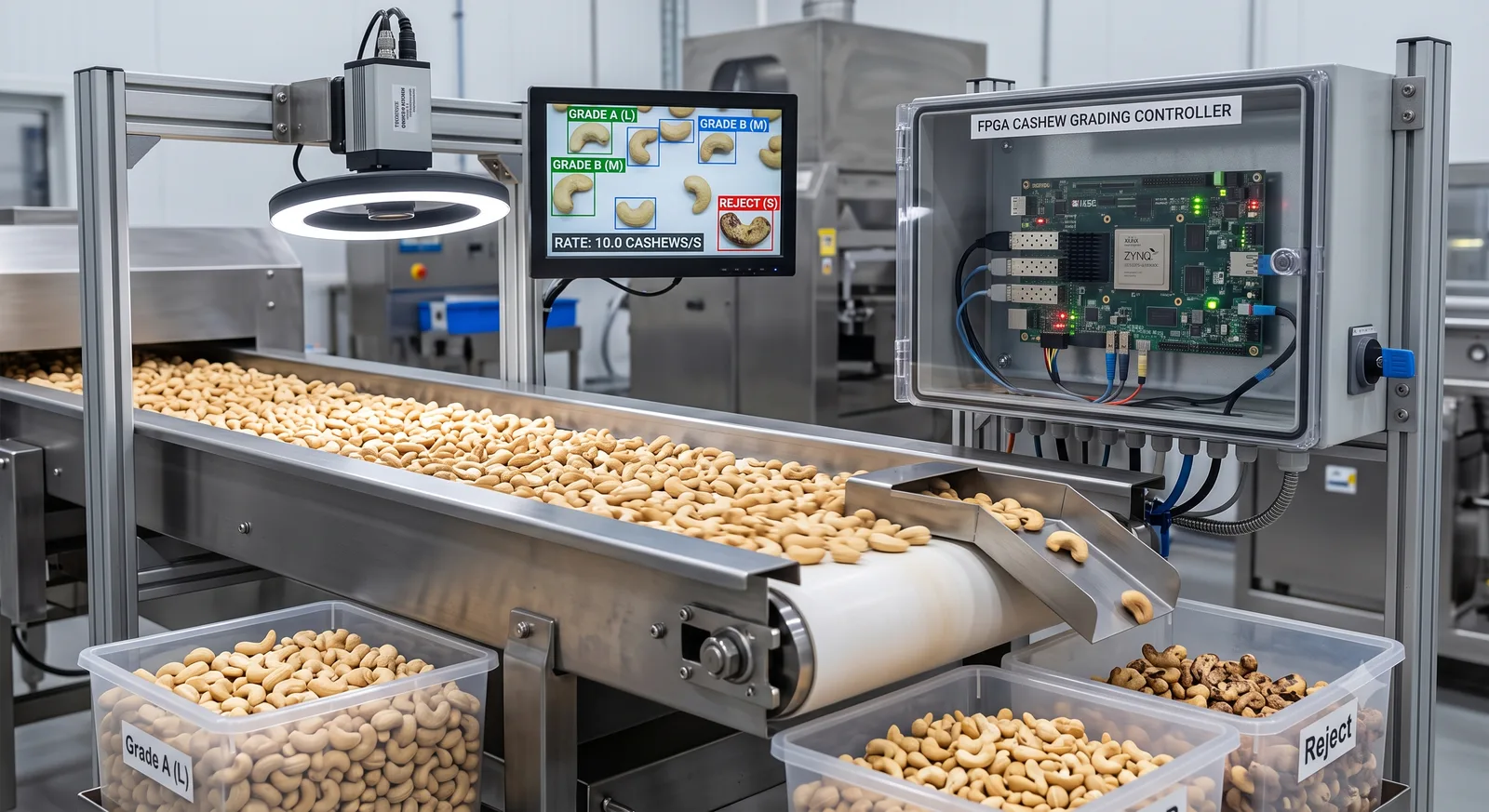
An automated cashew-grading system that uses machine learning and image processing to grade cashews by size and identify bad-quality nuts. A conveyor belt positions one cashew per camera frame while a custom FPGA-based board processes images and grades at ~10 cashews/second, automatically diverting each nut to its respective container.
Indian Cashew Processing Industry
IN
Agriculture
An automated orange inspection and sorting system using image processing and multiple cameras to grade fruit by colour and surface characteristics. Oranges move individually along a conveyor while multiple cameras cover every side; a processor-based board detects blemishes and yellow/green/dark areas, classifies each orange (good, bad, unripe, over-ripe) and diverts it to the respective container.
EU