






Transformation-invariant matching
Matches features between neighbouring tiles even when they are rotated, scaled or translated.
Accreditations









Case Study · US-based Healthcare Imaging Company
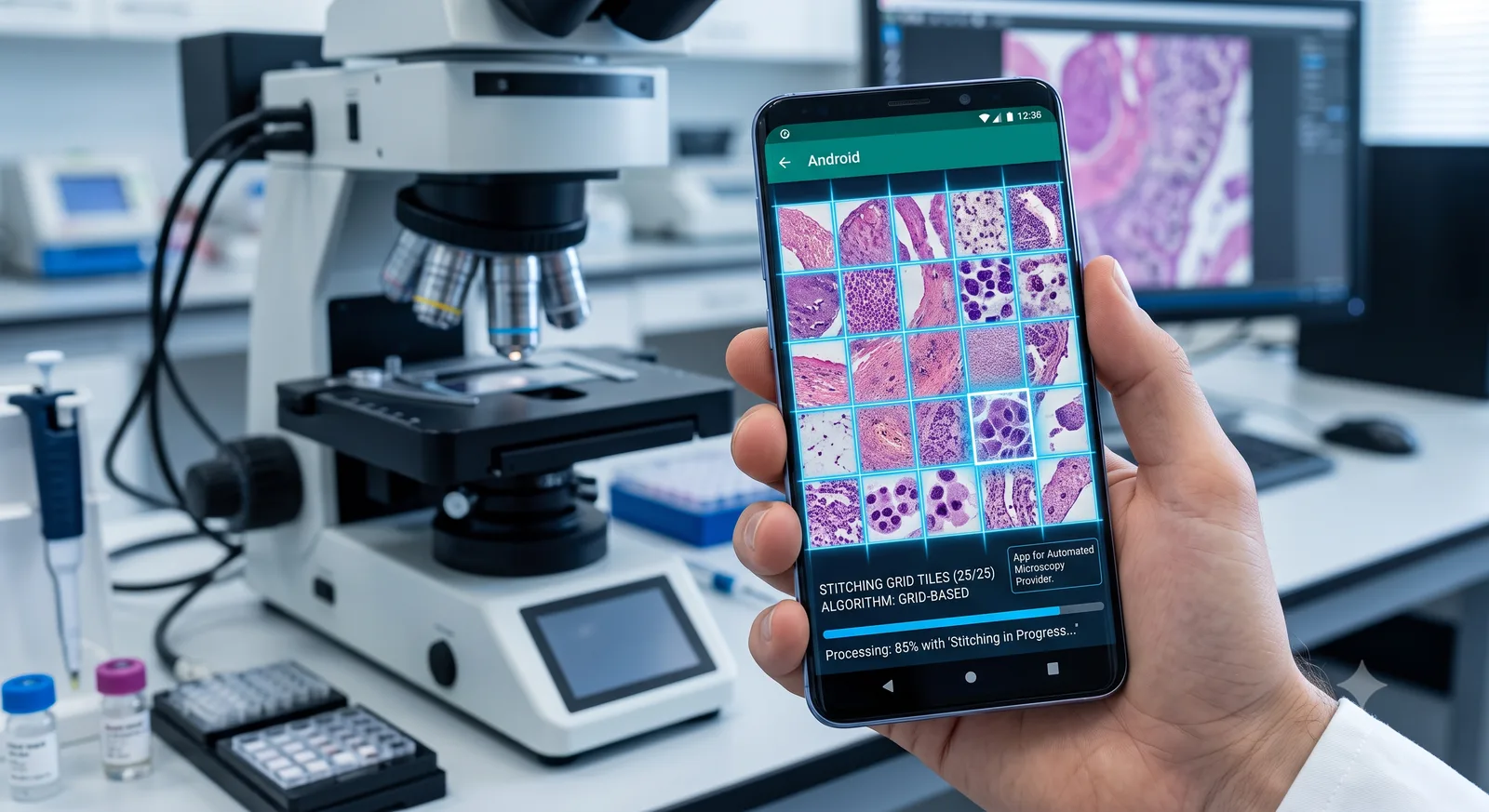
A robust grid-based image-stitching algorithm for microscopic images, deployed on Android and desktop. An automated microscope generates a grid of partially overlapping tiles, and the algorithm matches features between neighbours — regardless of rotation, scaling or translation — assembling hundreds of tiles into a single mosaic using a Minimum Spanning Tree.
Industry
Healthcare
Region
US
Year
2021
Healthcare / Image Processing / Computer Vision
The project focuses on developing a grid-based image-stitching algorithm for microscopic images and deploying the solution on an Android application. The microscopic images have uniform backgrounds and, to some extent, uniform foregrounds — characteristics that demand a robust stitching algorithm. The objective is to take hundreds of partially overlapping microscopic image tiles and combine them into a single mosaic image.
Business requirements & challenges
An automated microscope acquires images as a grid of partially overlapping tiles rather than one large image. The system must determine how those tiles relate to each other and combine them into one larger image.
Key requirements
Solution
A specialised image-stitching algorithm was developed to match features between neighbouring images — working even when images have been rotated, scaled or translated. Using this algorithm, hundreds of overlapping tiles can be stitched into a single mosaic image.
Stack
How it works
What's new
Matches features between neighbouring tiles even when they are rotated, scaled or translated.
Estimates how much neighbouring images overlap and the camera angle to establish correct spatial relationships.
Replaces high-uncertainty computed translations with an estimated median value for robustness.
Optimises across all translations for a consistent arrangement of the full tile set.
Assembles the tiles into a single mosaic using a Minimum Spanning Tree.
Handles hundreds of partially overlapping tiles captured in a grid by an automated microscope.
Business benefits
At a glance
| Region | US-Based Company |
|---|---|
| Input | Microscopic image tiles |
| Image Acquisition | Automated microscope |
| Image Pattern | Grid of partially overlapping images |
| Core Technology | Image Stitching |
| Feature Matching | Neighbouring images |
| Transformations Supported | Rotation, Scaling, Translation |
| Processing | Overlap & camera-angle estimation |
| Uncertainty Handling | Estimated median value |
| Optimization | All translations |
| Assembly | Minimum Spanning Tree |
| Output | Mosaic image |
| Platforms | Android + Desktop |
| Key Application | Time-lapse cell culture studies |
Related
Healthcare
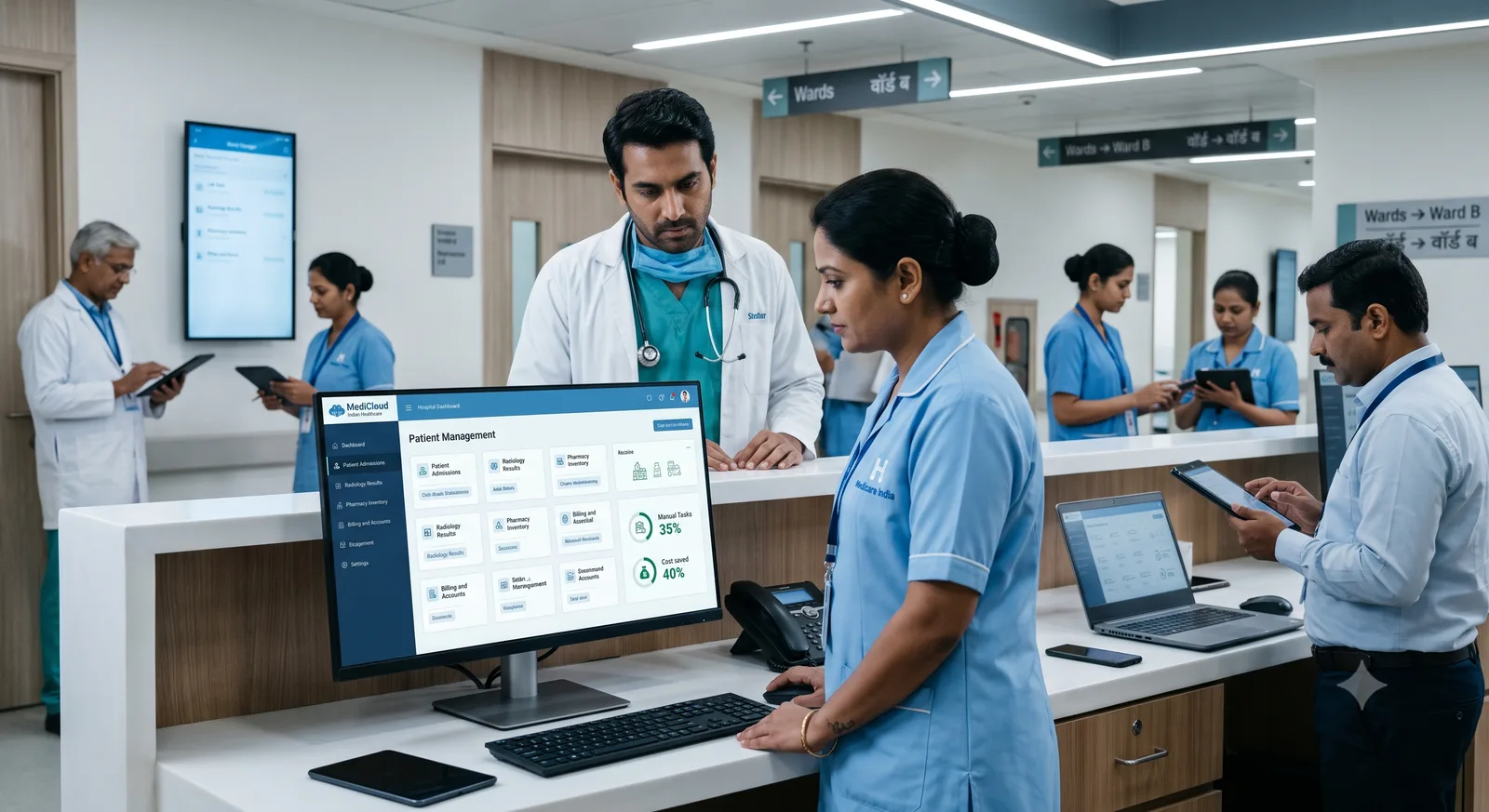
End-to-end consultancy and cloud ERP transformation for a leading Indian hospital — an AS-IS analysis across People, Process, System and Data yielded 100+ improvement suggestions across 12 departments, digitalising patient records, notes, e-prescriptions, reports, queuing and cashless payments toward a paperless environment. Reduced manual activities ~35%, saved 50%+ of doctors' time in select departments and cut costs 40%.
Leading Indian Hospital Chain
IN
35%
reduction in manual activities
Healthcare
Application Management Services (AMS) support for an already-implemented healthcare ERP used by more than 200 concurrent users, with patient medical records and financial details on a centralized server. An offsite AMS team with a 24×7 help desk delivered detailed root-cause and performance analysis, performance tuning, hotfixes and continuous improvement, plus customized modifications and upgrades. The engagement improved third-party reporting (insurance, corporate clients and Government departments such as MA Yojna), defined backup and cloud-solution strategies, and cut technical issues and data disputes.
Major healthcare organisation
IN
Healthcare
A cloud-based solution integrating the entire chain of healthcare providers and units across locations into a single ERP — enabling cross-location patient-information sharing, single-point information access, centralised analytics and reports, paperless and cashless operations, and configurable treatment protocols. Processes were re-engineered to be patient-centric, letting a single client receive service from any provider while cutting treatment and basic-service costs.
Global health care chain